Biology
Borer larvae and eggs: the stage you cannot see
Almost all of a borer's life happens inside the wood, as a grub you will never see. Understanding that hidden stage explains why holes appear long after the damage starts, and why a borer inspection reads the timber rather than counting holes.
First published · updated
Borer eggs are laid on rough timber surfaces, in cracks or in old exit holes, or in the case of powderpost, inside the pores of hardwood. The larvae then feed inside the wood for about one year (powderpost), two to three (huhu), three to four (common house borer) or two to eleven (longhorn). Exit holes appear only when adults leave, so they always trail the damage.
Where do borer lay their eggs?
House borer females lay small white eggs on rough-sawn surfaces, in cracks and crevices, or in old exit holes. The NZ Farm Forestry Association records that they hatch in four to five weeks, and some females laid more than 100 eggs in laboratory tests. Consumer NZ gives a similar figure of up to 100 eggs.
The other beetles choose differently. Longhorn eggs go into cracks or under rough projections of sawn timber, and in buildings mostly in damp, poorly ventilated places. Powderpost females push an egg-laying tube 5 to 6 mm into the pores of hardwood and lay two or three eggs in each. Huhu need wood moist enough for newly hatched larvae to establish.

For a house, this means bare, rough, unsealed timber is the most inviting surface: subfloor joists, the backs of weatherboards, the undersides of floorboards and the unfinished parts of furniture. Old exit holes double as ready-made egg sites, which is one way an infestation feeds itself.
How long do borer larvae live inside the timber?
Years, for most species. Common house borer larvae take about three years in kahikatea sapwood and four in rimu or radiata pine. Longhorn larvae take anywhere from two to eleven years. Huhu usually take two to three, and powderpost usually complete the whole cycle in about a year.
| Beetle | Egg hatches in | Larval feeding | Adults leave |
|---|---|---|---|
| Common house borer | 4 to 5 weeks | About 3 years in kahikatea, 4 in rimu or radiata pine | Mostly November to January |
| Two-toothed longhorn | 2 to 4 weeks | 2 to 11 years, slowest in dry heartwood | Autumn to early winter |
| Powderpost beetle | 8 to 12 days | Usually about a year for the whole cycle | October and November |
| Huhu | Not stated | Usually 2 to 3 years | November to early March |
The adults, by contrast, last only weeks. House borer adults live up to about four weeks and do not feed. The long larval stage is the whole story of the damage.
What does a borer larva look like?
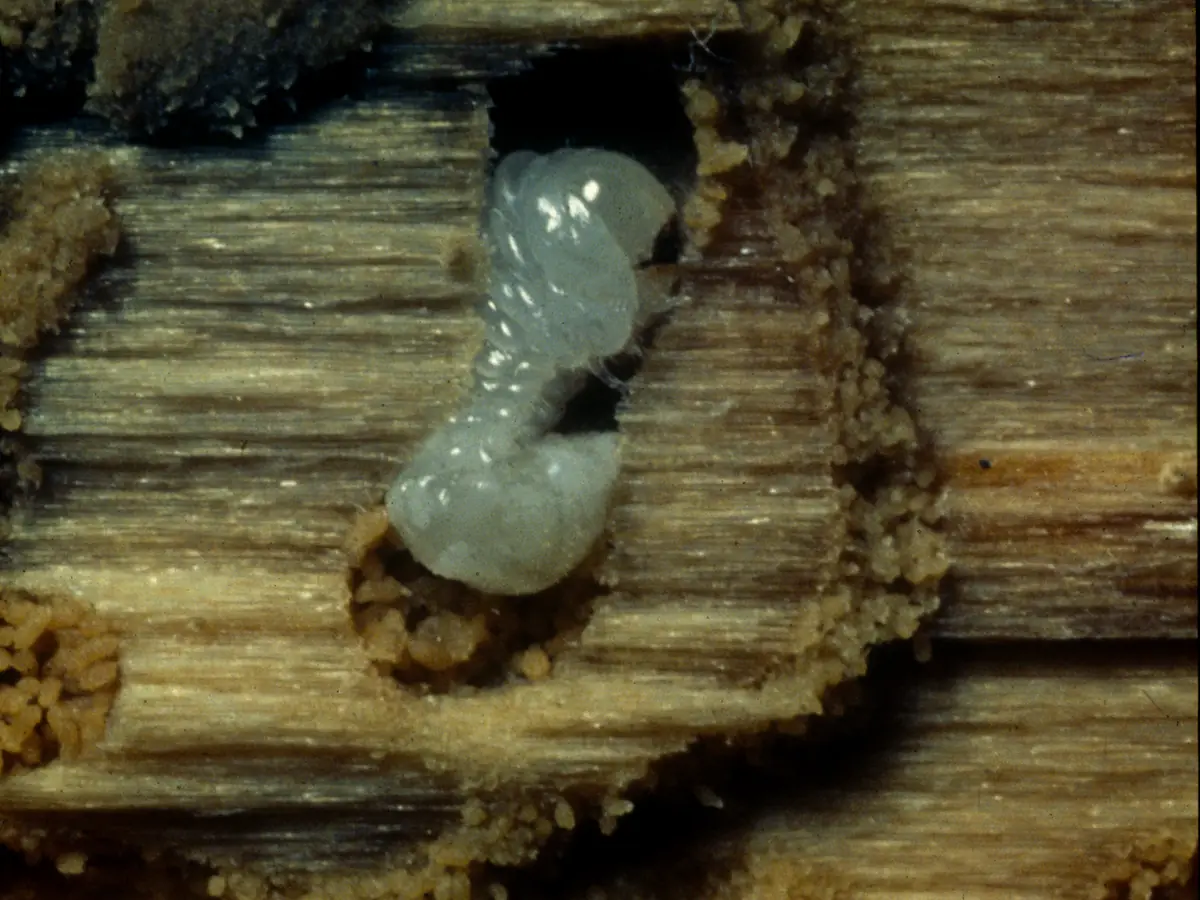
House borer larvae are small, white grubs curled into a C shape with short legs, according to English Heritage, and they are almost never seen because they stay in their tunnels. Huhu grubs are the exception: Manaaki Whenua and the NZ Farm Forestry Association describe them growing to about 50 to 70 mm.
You are only likely to see a larva when timber is cut, split or pulled apart during repairs. A white grub found in a damp, crumbling piece of framing may be huhu; tiny grubs in a dry floorboard are more likely house borer. Either way, the find confirms life inside that piece of wood at that moment, which an exit hole cannot do.
Why do exit holes lag behind the damage?
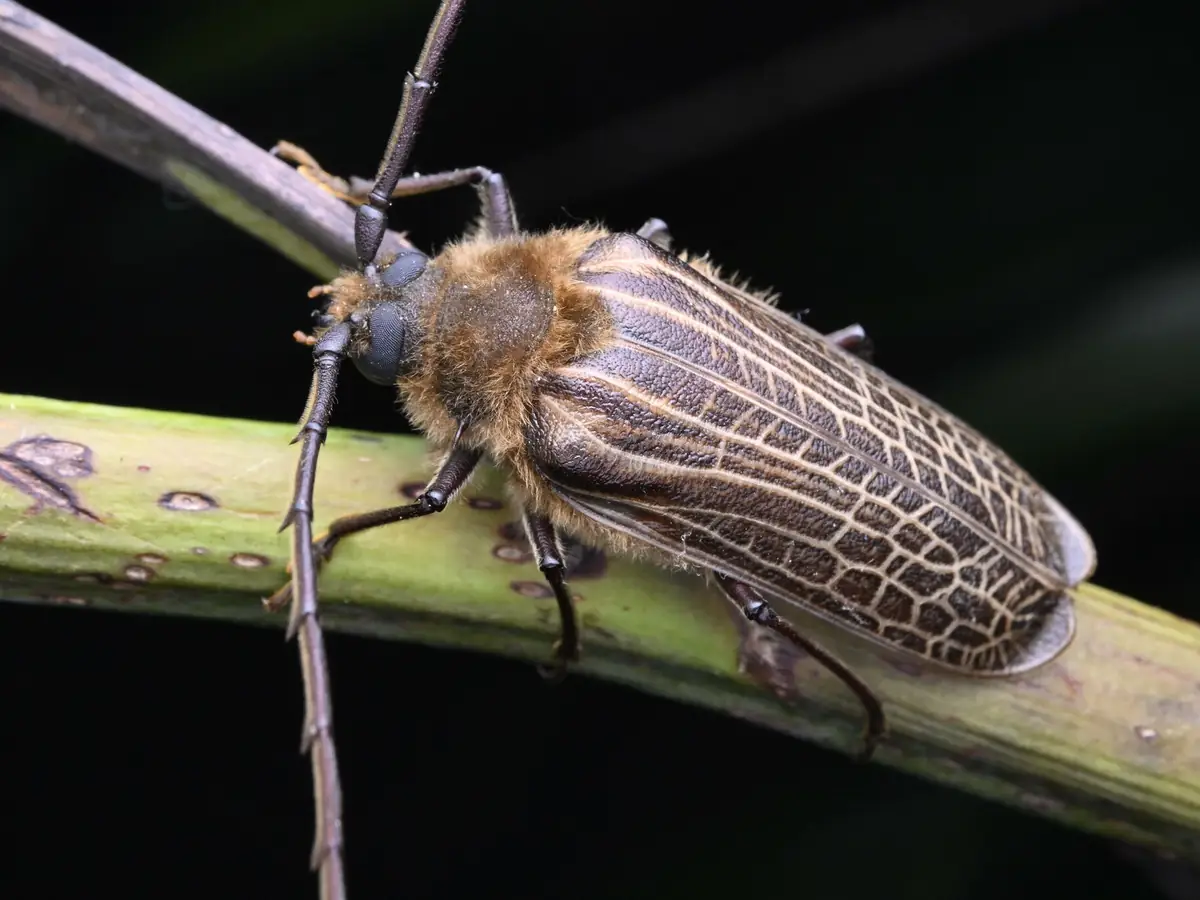
Because a hole is made only at the end of the cycle, when an adult chews out. A house borer egg laid this summer produces a hole three or four summers later, and a longhorn egg may take a decade. In the meantime the larva has been tunnelling unseen, and the surface can look clean.
This has two consequences for an owner or buyer. First, a board with few holes can already carry several generations of larvae at different stages. Second, the holes you can see record past emergence. They show where adults left, which is not always where larvae are feeding now. The longhorn guide explains why longhorn timber is probed rather than judged from its face.
What speeds borer larvae up or slows them down?
Moisture and warmth. House borer develops fastest above about 70% relative humidity and at around 22 to 23.5 degrees. Longhorn development is slowest in dry heartwood at low temperatures. Huhu need timber at or above about 25% moisture, and powderpost larvae need wood moisture between about 8 and 30%.
English Heritage adds that house borer eggs and young larvae do not survive in wood below about 12% moisture or air below 55% relative humidity. That is a UK figure, but it explains why dry, heated rooms hold less activity than damp subfloors. The subfloor guide covers why ventilation and moisture form part of the finding.
What does the life cycle mean for reading an inspection?
It means an inspection reports what the evidence supports, not certainty about every larva. The finding separates historic holes from fresh signs, notes where moisture favours larvae, and flags timber whose strength is in question. Where activity is unclear, the honest answer is to mark the area and check again.
A report that says "no fresh activity observed" is a statement about the day and the season, which is why the month of the visit is recorded. Buyers reading a building report should keep that in mind, and owners after a treatment should expect the confirmation to take at least one flight season. The flight season calendar shows when emergence is likely.
Why does one quiet summer not prove borer has gone?
Because the next adults may simply not be due yet. With larvae taking three to four years in house borer and up to eleven in longhorn, a season without fresh holes or dust can be a gap between generations. Repeated clean checks across seasons are more convincing than one.
That is also why a single fresh hole in a treated area does not automatically mean a treatment failed: an adult that was nearly grown may still chew out. What it means depends on timing and on what else is found, which the borer treatment page explains in the context of a live finding.
When the reading turns into a decision about one real house, the fee, the report and the booking steps are set out under Lignum Timber.
Asked about this
How long do borer larvae live?
Common house borer larvae feed for about three years in kahikatea and four in rimu or radiata pine. Two-toothed longhorn larvae can take two to eleven years, huhu usually two to three, and powderpost about one.
Can you see borer eggs?
Rarely. House borer eggs are tiny and white, laid in cracks, on rough-sawn surfaces or in old holes, and they hatch within about five weeks. In practice no one finds them during an inspection; the evidence comes from holes, dust and the state of the timber.
Does a new borer hole mean new borer?
It means an adult has just left that spot, so the timber was producing beetles until recently. It does not tell you whether more larvae remain behind it. Fresh dust and further holes over the following seasons answer that.
Do borer larvae die if the wood dries out?
Drier wood slows them, and the young stages of house borer struggle in very dry timber, but established larvae can keep going for some time. Drying is part of the answer for subfloors. It is not proof the borer has gone.
Read next
- Flight seasonThe months each borer flies in New Zealand, and what that means for treatment and for buyers
- Borer dust and frassWhat wood borer dust looks like by species, fresh against old, and how termite droppings differ
- House borer by build yearWhich New Zealand houses carry house borer, era by era, and why the framing timber decides it
- Treating live borerWhat treatment involves after a live borer finding: bare and finished timber, timing, moisture and follow-up
Sources
- NZ Farm Forestry Association: household borer, Anobium punctatum
- NZ Farm Forestry Association: two-toothed longhorn, Ambeodontus tristis
- NZ Farm Forestry Association: powder-post beetle, Lyctus brunneus
- NZ Farm Forestry Association: huhu beetle
- Manaaki Whenua Landcare Research: huhu grub
- Consumer NZ: borer and other pests
- English Heritage: furniture beetle fact sheet
Book a borer inspection
The inspection is $285 + GST, credited against treatment done through the same operator. Treatment ranges sit on the cost page.