East Auckland · Howick ward
Borer inspection in Botany
Botany is young by Auckland standards, and that is exactly why its houses deserve a closer look. Much of it was built while untreated framing was allowed. A pre-purchase borer inspection answers whether that matters for one particular house.
Large parts of Botany, Dannemora and Flat Bush were built in the late 1990s and early 2000s, when New Zealand allowed untreated kiln-dried pine framing. That framing has no borer protection. The risk is real but specific: it depends on the consent date, whether the timber has stayed dry, and what the inspector can actually reach.
An inspection costs $285 + GST. The fee is credited against the treatment if you go ahead with the recommended work through the same operator.
From East Tāmaki farmland to a town centre
An aerial photograph from 1959 shows Botany Downs as farmland. It was developed into suburban housing from the mid-1970s. Dannemora followed in the 1990s and early 2000s: when Point View School opened there in 1997 the surroundings were still mostly farms. Botany Town Centre opened in May 2001, and the first Flat Bush neighbourhood centre, at Chapel Road, in 2004.
That gives the area an unusual housing profile for Auckland. Very little is older than the 1970s, and a large share was built in a single decade around the turn of the century. A government study of the area in 2005 described a mixture of conventional and medium-density housing that went up quickly around the new centre.

The untreated framing window, date by date
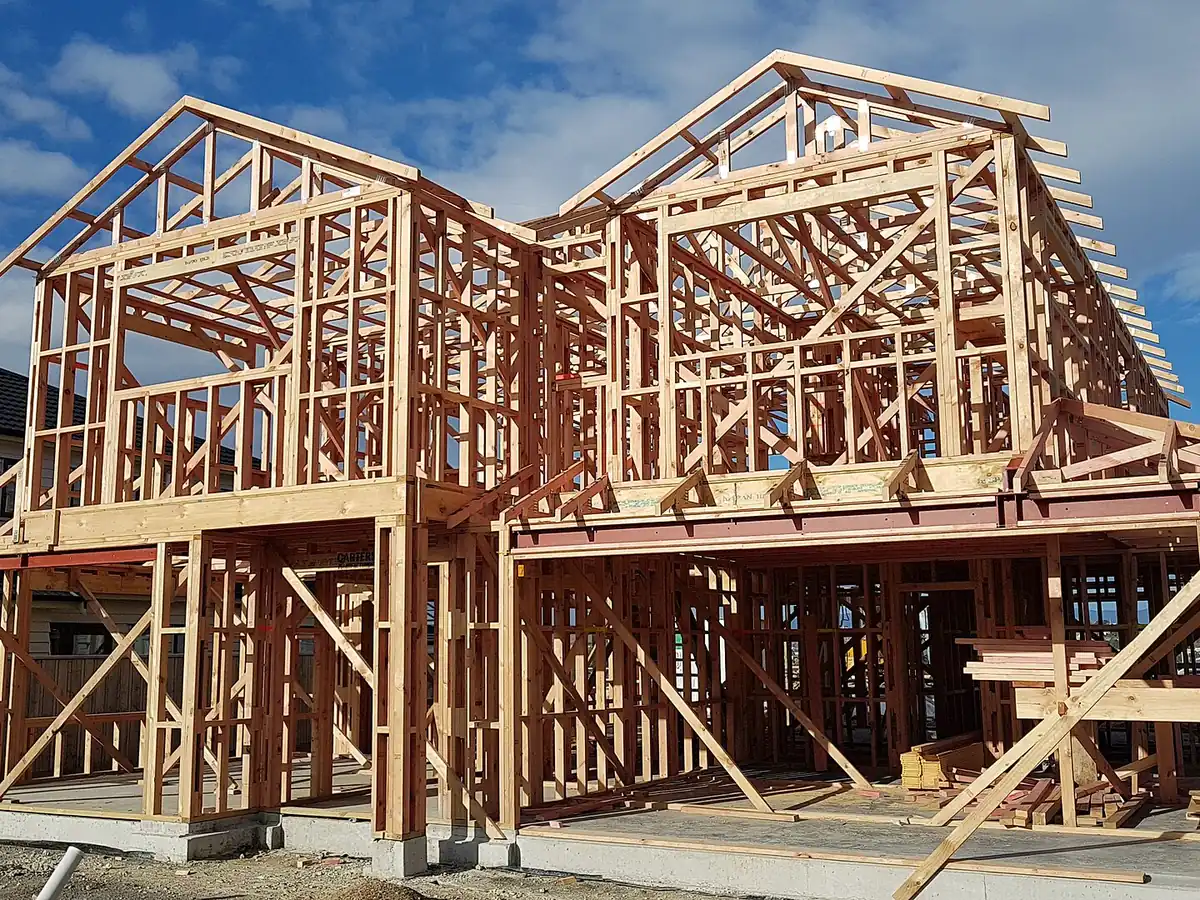
New Zealand framing was routinely boron-treated for decades, until a change to NZS 3602 in September 1995 allowed untreated kiln-dried pine framing where its moisture content in service would stay at or below 18 per cent. Treated framing became compulsory again for consents from 1 April 2004. That window is the core of the borer question for many Botany homes.
| Date | What changed |
|---|---|
| 1952 | Wet boric treatment of framing timber first introduced |
| 11 September 1995 | NZS 3602:1995 allows untreated kiln-dried framing if in-service moisture stays at or below 18% |
| 28 February 1998 | The change is cited in the Building Code's Acceptable Solution B2/AS1 |
| 1 April 2004 | Treated framing required for all new building consents (BIA Directive 23) |
| 1 April 2005 | Last date for completing houses consented earlier with untreated framing |
| April 2011 | H1.2 boron treatment becomes the standard for framing under B2/AS1 |
Because of the gap between consent and completion, the risk period is best stated as roughly 1995 or 1998 to 2004 or 2005, not as exact years. A house finished in 2003 may or may not have untreated framing; the council property file and the timber itself are the only ways to know.
Why build year beats suburb name in Botany
Botany Downs houses from the 1970s and 1980s were framed when boron treatment was normal, so their framing is a modest borer risk. Many Dannemora and early Flat Bush homes fall inside the window. Homes consented after April 2004 should have treated framing. Three houses in neighbouring streets can therefore carry three different risks.
Look up the building consent and code compliance certificate dates on the council property file or LIM before booking anything. If the consent falls between 1995 and 2004, the framing deserves a check whatever the house looks like. The untreated framing guide sets out the window in detail, and borer in newer houses covers what still turns up in homes built after it.

Plaster cladding, moisture and the borer link
The same rule change that allowed untreated framing is widely linked to the worst of the leaky-building damage of that era; the Bioeconomy Science Institute, formerly Scion, says the move to untreated framing made that damage worse. In Botany Downs, the Sacramento condominium development of 2000 is one well-known example of that crisis.
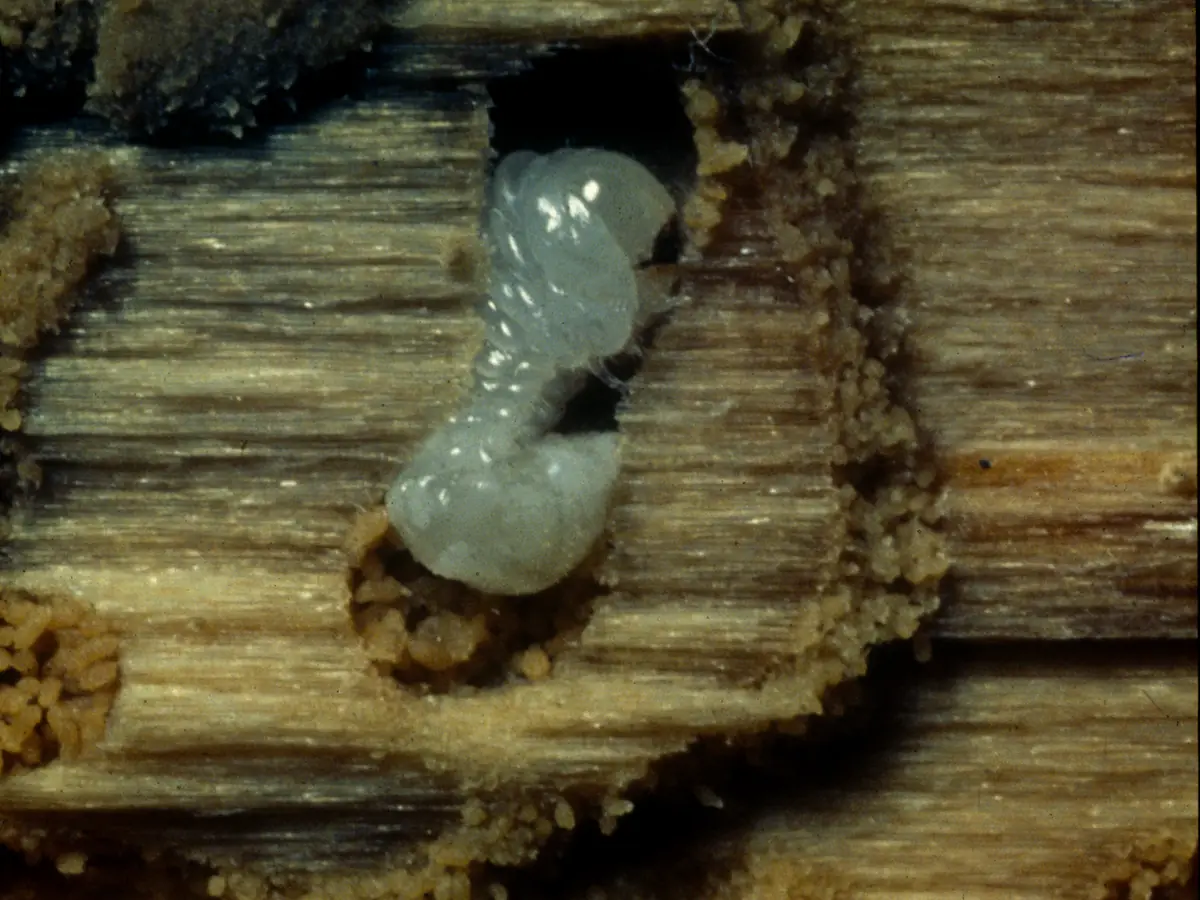
For borer the link is moisture. Untreated framing that stays dry is a fairly poor home for the common house borer. Framing that gets wet behind cladding can rot, and wet untreated wood can draw huhu, whose larvae NZFFA notes have destroyed untreated building timber in damp conditions. A borer inspection is not a weathertightness survey: if moisture is suspected, a building surveyor with moisture testing is the right person, and the borer findings say so plainly. For what huhu in framing implies, see huhu in the house.
What can an inspector see in a 1990s house?
Less than in an old villa, and the findings say so. Wall framing in a 1990s or 2000s house is lined on both sides, and many houses of the era sit on a concrete slab, which leaves no subfloor to enter. The roof space is often the main place where framing can be seen directly.
- Roof framing and trusses. Checked for exit holes, dust and any treatment marks. H1.2 framing is colour-coded pink, so plain, unstained timber in the roof is a clue worth recording.
- Garage and service areas. Unlined garage walls sometimes show framing that is hidden elsewhere.
- Openings. Ceiling hatches, meter boxes and cupboards under stairs can give a view into framing.
- Timber floors. Where the house has a suspended floor, the subfloor is checked like any other.
What cannot be seen is listed as not inspected. Nobody removes linings during a borer inspection.
Before you buy in Botany: questions worth asking
A few questions settle most of the uncertainty before you spend money on reports. Ask for the consent date and code compliance certificate, ask whether the house has been reclad or had moisture repairs, and ask whether any framing was replaced during that work and with what.
Then book the building report and the borer check together, inside your due-diligence period. If the reports disagree or one says only "evidence of borer", borer in a building report explains how to read that line, and is borer a deal breaker sets out when borer should change what you offer. Prices for each step are on borer cost.
For a sense of the other end of Auckland's housing, Onehunga is a suburb where almost everything predates 1952.
Every other suburb gets the same visit and the same report format; the overview is under Lignum Timber Inspections.
Asked before booking
Is every Botany house built between 1995 and 2004 untreated?
No. Untreated kiln-dried framing was allowed, not required, and many builders kept using treated timber. The only way to know is to check the timber where it can be seen, along with the consent records. That is why the date range is a reason to check, not a verdict.
Does untreated framing mean the house has borer?
No. It means the framing has no treatment to resist borer. Kiln-dried framing that stays dry is a fairly poor home for the common house borer. The bigger concern is framing that has been wet, which can rot or draw huhu.
Can a borer inspection tell me if the house leaks?
No. It records signs of moisture it can see, such as stained timber in the roof space, but it does not test wall moisture or assess cladding. For that you need a building surveyor. The borer findings will say if a weathertightness check looks wise.
How do I find the consent date for a Botany house?
Order a LIM or request the property file from Auckland Council. Both show building consents and code compliance certificates. Your lawyer or the agent may already have them as part of the sale.
Reading before you buy in Botany
- Untreated framing yearsHouses from the untreated kiln-dried framing window of about 1995 to 2005, and what that means for borer
- Pre-purchase borer inspectionA borer check timed to your building condition, read alongside the building report
- Huhu in the houseWhy huhu in house timber points to wet wood, and where the moisture usually comes from
- Is borer a deal breaker?When borer should change an offer on a house, and when it should not
Sources
- Standards New Zealand: key historical dates for timber treatment regimes
- Bioeconomy Science Institute: how science has changed timber building
- BRANZ: H1.2 framing timber treatment
- NZ Farm Forestry Association: huhu beetle, leaflet 35
- Wikipedia: Botany Downs (development, Sacramento condominiums)
- Wikipedia: Dannemora, New Zealand (1990s to 2000s development)
- Wikipedia: Botany Town Centre (opening, 2005 planning study)
- Consumer Protection (MBIE): building reports, red flags
Book a borer check for a Botany house
The inspection is $285 + GST, credited against treatment done through the same operator. Treatment ranges sit on the cost page.