West Auckland · Waitākere Ranges
Borer inspection in Titirangi
A Titirangi house is usually a timber house under trees, on a slope, with the Manukau Harbour somewhere below it. Those three things shape what a borer inspection finds here more than the age of the building does.
In Titirangi the question is often moisture before it is beetles. Houses set into native bush on steep, shaded ground keep their lower timbers damp, and damp timber is what the native two-toothed longhorn and the huhu need. The inspector works out which beetle is present, whether the wood around it is wet, and what is drying it out or not.
The inspection costs $285 + GST and covers the whole of Auckland, Titirangi and Laingholm included. The fee is credited against the treatment if you go ahead with the recommended work through the same operator.
Why does timber stay wet in Titirangi?
Most Titirangi houses sit on slopes under a canopy, so the sun rarely reaches the downhill side of the subfloor or the lower weatherboards. Leaf litter builds up in gutters and against cladding, rain runs down the hill and under the house, and gullies hold cool, still air. Timber in those spots dries slowly after every wet spell.
That matters for borer because the beetles differ in what they need. The common house borer develops fastest when the air is humid, above roughly 70 per cent relative humidity according to the NZ Farm Forestry Association, so a shaded, poorly vented subfloor suits it. The native two-toothed longhorn and the huhu go further and are tied to wood that is properly damp. A dry, sunny villa on the isthmus and a bush house here can share a build year and still carry quite different risks.


Huhu and longhorn: the bush-house beetles
Two native beetles matter more in Titirangi than in most of Auckland. The huhu, New Zealand's largest beetle, breeds in dead and damp wood; NZFFA notes that young larvae need moist timber to establish and older ones keep feeding while moisture stays at or above about 25 per cent. Huhu in a house therefore points to a leak, a buried bearer or a wet wall.
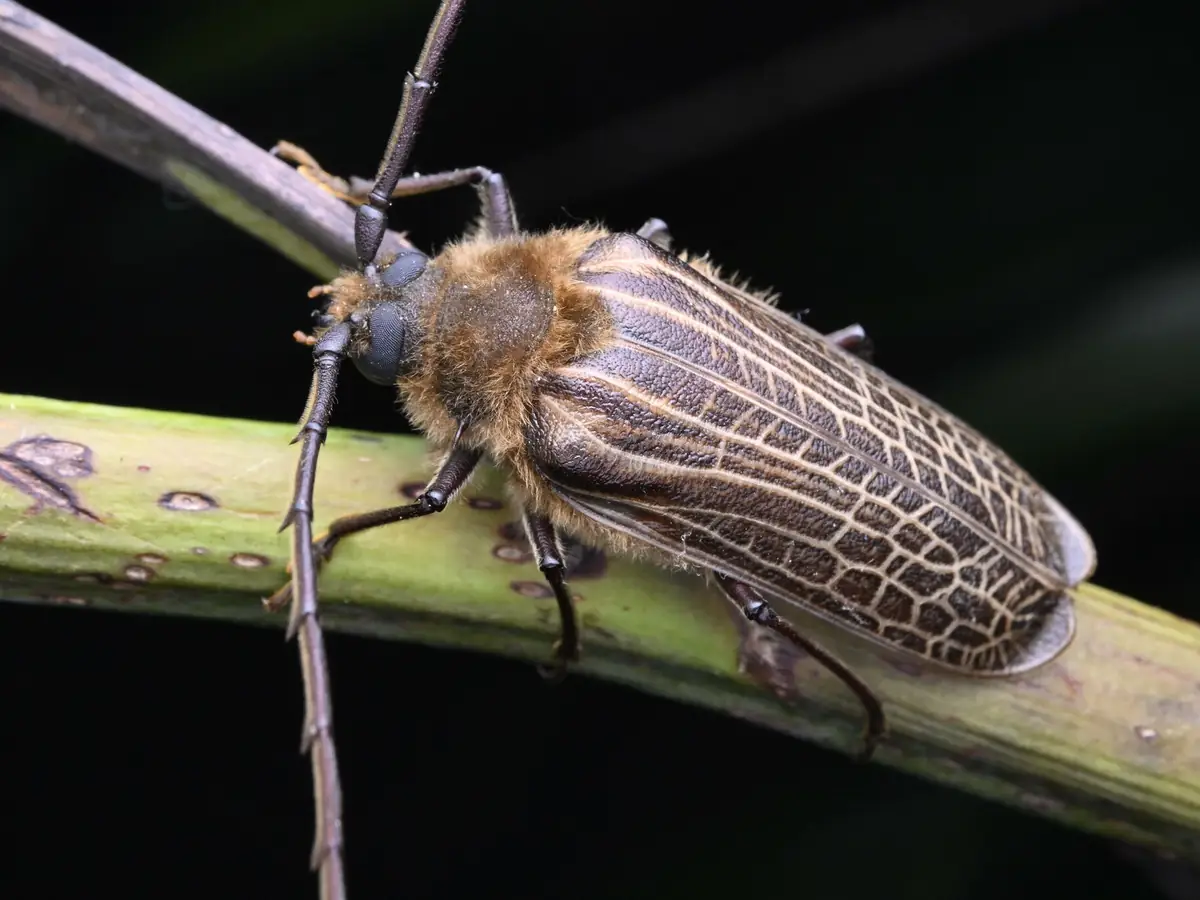
The two-toothed longhorn leaves oval exit holes about 3 to 7 mm long, emerges in autumn and early winter, and, unlike the common house borer, tunnels through heartwood as well as sapwood. Rimu and kahikatea are among its usual hosts. Its larval stage can run anywhere from 2 to 11 years depending on moisture and temperature, so damage can grow quietly inside a joist that looks sound from outside. The species guides explain the signs: two-toothed longhorn and huhu in house timber.
The common house borer still turns up, mainly in the sapwood of untreated rimu, kahikatea and pine, in older floors and roof framing. What changes the recommendation in Titirangi is usually which of the three it is, and whether the wood around it is wet.
From kauri country to a suburb in the trees
Titirangi was logged before it was lived in. The Manukau shoreline was worked for kauri in the mid-1800s, much of the area was farmed from the 1860s, and the first recorded land purchase dates from 1848. The opening of Exhibition Drive, now Scenic Drive, in January 1914 brought the first real township growth, and the bush began to come back over the old farmland after the First World War.
The bigger wave of houses came from the 1960s, when better roads made the hills commutable. The result is a suburb of mixed eras: early cottages rebuilt or extended many times, houses from the 1960s and 1970s, and later homes built among regenerating bush. Some were raised on poles so they could be built without harming the roots of nearby trees. A single property can therefore hold untreated native timber in one part and boron-treated framing in another, which is why the inspector records timber part by part.
Getting under pole houses and down steep sections
Access takes more planning here than in most suburbs. A pole house may have a tall, open underside that is easy to see but hard to reach at the top, while a house cut into the slope can have almost no clearance at the uphill end and head height at the other. Paths are often steep, wet and covered in leaves.
- Poles and bearers. The inspector looks at where poles meet bearers and where timber touches soil or retaining walls, since that is where moisture gathers.
- Decks and stairs. Many Titirangi houses are reached by long timber stairs and decks. They are outside the house but can be included if you ask.
- Low uphill subfloors. Spaces too tight to enter safely are inspected from the hatch with a light and recorded as part-seen, not guessed.
- Roof spaces. Low-pitched roofs on mid-century houses can leave little room; the findings say where the inspector could and could not reach.
It helps to mention a steep driveway, a locked undercroft or a long walk from the road when you book. The piles and subfloor page explains what is normally reached under any house.
The Waitākere Ranges Heritage Area and your repairs
Titirangi lies inside the Waitākere Ranges Heritage Area, set up by the Waitākere Ranges Heritage Area Act 2008, which Auckland Council gives effect to through the D12 overlay of the Unitary Plan. The overlay is mainly about subdivision, landscape and intact native vegetation. It does not stop ordinary repairs, but it is a reason to check with the council before clearing bush.
That comes up because the obvious fix for a damp subfloor is more air and light, and the obvious way to get it is to cut back the vegetation around the house. Before removing trees or bush, check the overlay and any other rules on your title with Auckland Council. Like-for-like replacement of a few damaged boards or joists is usually exempt building work; larger structural replacement is not, as set out on borer damage repair.
Kauri grow throughout these hills. MPI's Tiakina Kauri programme asks anyone moving or working around kauri to follow its hygiene protocols, so it is fair to ask for clean boots and equipment before anyone goes under a house near kauri roots.
What the inspection concentrates on in a Titirangi house
The inspection follows the moisture. Downhill subfloor framing, bearers near the ground, the bottom boards of the cladding, the sills of large windows facing the bush, and any timber against a retaining wall get the most time. The roof space is checked as well, but it is rarely where the trouble starts on a site like this.
-
Identify
Read exit holes and dust to tell longhorn, huhu and house borer apart.
-
Probe
Test suspect bearers and joists for softness, which can be rot, insect damage or both.
-
Measure
Note damp timber, blocked vents, leaf build-up and ground water under the house.
-
Separate
Record what needs treatment, what needs drying out first, and what needs a builder.
Treating wet timber without dealing with the water rarely lasts, so the written findings put drainage, ventilation and leaks alongside any recommendation for borer treatment. Why water and borer travel together is explained in borer and moisture.
Buying in the hills: timing the borer check
If you are buying in Titirangi, book the borer check as soon as your offer is accepted, alongside the building report. Access to steep and wooded sites takes longer to arrange, and an autumn inspection can catch longhorn emerging while a summer one is more likely to show the common house borer.
A standard building report is a visual survey of the whole house and may note only that borer is present. The pre-purchase borer inspection adds which beetle, how far it reaches and whether moisture is driving it. If you are weighing the price, is borer a deal breaker sets out when borer should change an offer and when it should not.
Across the harbour inlets to the east, Onehunga has older housing on flatter, faster-draining volcanic ground, a useful contrast if you are comparing houses on both sides.
Every other suburb gets the same visit and the same report format; the overview is under Auckland borer inspection.
Asked before booking
Is huhu in a Titirangi house a sign of a bigger problem?
Usually it is a sign of water. Huhu larvae need damp wood to get started, so finding them in house timber points to a leak, poor drainage or timber in contact with wet ground. The timber around them also needs checking for rot, and the moisture source needs fixing before any treatment is worth doing.
Can I cut back bush to dry out my subfloor?
Possibly, but check first. Titirangi is inside the Waitākere Ranges Heritage Area, and the Unitary Plan has rules protecting native vegetation in parts of it. Auckland Council can tell you what applies to your section. Better drainage, clearing gutters and unblocking vents often help without removing any trees.
When is the best time to inspect a bush house?
Any time of year works for reading damage and moisture. Autumn and early winter suit the two-toothed longhorn, which emerges then, while late spring and summer suit the common house borer. If you are buying, the right time is before your conditions expire, whatever the season.
Will the inspector go under a pole house?
The inspector looks at everything that can be reached safely: poles, bearers, joists and the underside of the floor. Parts too high or too tight to reach are viewed from the nearest safe point and listed as part-seen in the findings, so you know exactly what was and was not examined.
Reading for Titirangi owners
- Borer and moistureHow humidity, damp subfloors and timber moisture drive borer, and what moisture readings in findings mean
- Two-toothed longhornThe native longhorn that tunnels through heartwood: oval holes, autumn emergence, damp subfloors
- Huhu in the houseWhy huhu in house timber points to wet wood, and where the moisture usually comes from
- Piles and subfloorBorer in piles, bearers and joists, damp subfloors, rot versus borer, and when replacement needs a consent
Sources
- Wikipedia: Titirangi (history, housing on poles, 2023 census)
- Waitākere Ranges Heritage Area Act 2008 (legislation.govt.nz)
- Auckland Unitary Plan, D12 Waitākere Ranges Heritage Area Overlay (Auckland Council)
- Tiakina Kauri (Biosecurity New Zealand, MPI)
- NZ Farm Forestry Association: huhu beetle, leaflet 35
- NZ Farm Forestry Association: two-toothed longhorn
- NZ Farm Forestry Association: household borer, leaflet 32
Book a borer inspection in Titirangi
The inspection is $285 + GST, credited against treatment done through the same operator. Treatment ranges sit on the cost page.